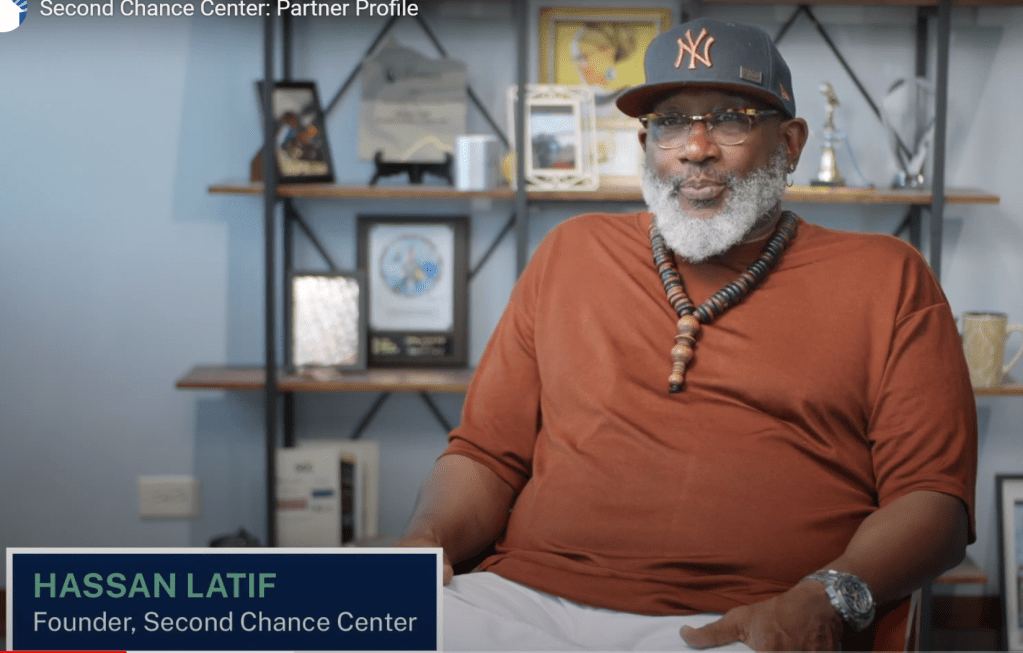
The Founder: Who is Latif Hassan Abdal?
Latif Hassan Abdal, the founder of Second Chance Center, claims to help formerly incarcerated individuals reintegrate into society. However, Abdal, who served 14 years in prison, presents a polished public image—attending events in designer attire, wearing luxury watches, and sporting diamond earrings. This raises questions: Is he truly a selfless advocate, or is he using his platform for personal gain?
• Abdal’s Background: Abdal, originally from New York, founded Second Chance Center in 2012, initially operating the organization from an apartment complex. While the organization may have started with genuine intentions, its evolution has sparked skepticism.
• A Change in Character? Abdal’s transformation—whether personal, spiritual, or financial—invites scrutiny. Has rebranding himself as a community leader erased his criminal past, or has it simply given him a new way to manipulate the system?
Abdal started Second Chance Center in 2012, initially operating the program from his car with little more than clothes, boots, and copies of his book Never Going Back: 7 Steps to Staying Out of Prison. In just seven years, the organization became Colorado’s largest community-based reentry program. By 2019, it employed 20 staff members and served around 1,300 people monthly, including parolees, individuals on intensive supervision, and those finishing sentences in halfway houses. The program offers mentorship, employment services, and social support, maintaining a recidivism rate under 10%—well below state and national averages.
Second Chance Center has received national recognition from organizations like the Urban Institute and the Public Welfare Foundation as a model for successful reentry. Abdal attributes this success to the fact that many of his staff share similar experiences with their clients.
Abdal’s personal story began in Brooklyn, where he grew up amidst violence and struggled with cocaine addiction. At 21, he was convicted of manslaughter after a violent drug deal and served three years in New York’s toughest prisons before returning to a cycle of addiction. His troubles followed him even after moving to Colorado.
“I don’t recognize that person anymore,” Abdal reflects. “He was quick to violence, didn’t respect others, and justified everything he did.”
Abdal was later convicted of armed robbery and served nearly 18 years in Colorado’s Department of Corrections. After spending 15 years fighting his charges, he eventually focused on preparing for life outside prison. Upon his release in 2006, Abdal entered addiction treatment, completed a year-long program, and began rebuilding his life. His initial goals were simple: stay sober, avoid crime, and work hard.
A few years later, Abdal became certified in addiction counseling and worked as a case manager at a reentry program. Frustrated by the program’s 50% recidivism rate, Abdal believed true success required more than just employment and housing—it required addressing substance abuse, mental health, and self-worth.
“Checking boxes wasn’t enough,” he explains. “You could give someone a job and a place to live, but if something inside them was still broken, they wouldn’t sustain their progress.”
When the program shut down in 2011, Abdal saw an opportunity to create something better. This led to the founding of Second Chance Center, designed to address both the practical and emotional challenges of reentry. Today, his vision has helped thousands, including Rollerson, break free from the cycle of incarceration.
Abdal started his outreach by driving his red 2002 Jaguar around, searching for people who might need help. “If I saw someone at a bus stop in khaki pants and plastic sneakers, I knew where they were coming from. I’d pull over and start a conversation,” he says. “I’d also find my way into halfway houses, practically begging to lead support groups.”
After securing the organization’s first federal grant, Abdal assembled a dedicated team, including Sean Taylor and Adam Abdullah.
Taylor, who was convicted of first-degree murder at 17 for his involvement in a gang-related shooting, turned himself in the day after the incident. Despite having no prior record, he was sentenced to life in prison and became eligible for parole in 2029. Abdal met Taylor in 1992 at Limon Correctional Facility, where Taylor was a teenager. “He was the first—and only—person I’ve met in prison devastated by the crime he committed, not the sentence,” Abdal recalls.
Taylor’s exemplary conduct in prison led to a review of his case by Governor Bill Ritter’s juvenile clemency board, which eventually commuted his sentence.
Abdullah, who served 33 years in federal prison, also joined the team. “He showed me a stack of certificates about an inch and a half thick, including two associate’s degrees,” Abdal recalls. “That was a waste of education and training.”
Together, Abdal, Taylor, and Abdullah moved Second Chance Center from Abdal’s car to a small office on Lima Street. They referred to themselves as the “Founding Fathers,” three Black men who collectively served 75 years in prison.
Following the Paper Trail
Nonprofits are required to submit regular filings, but Second Chance Center’s records suggest potential issues:
- Leadership Instability: In April 2024, Abdal stepped down as the registered agent for the organization, handing the role to Khalil Halim. Prior to this, Damond McCready held the position. Frequent changes in leadership can signal deeper instability or attempts to avoid accountability.
- Financial Concerns: How much money is the organization actually managing, and where is it going? Other Colorado nonprofits have been scrutinized for mismanaging funds while employing only a small staff. Could Second Chance Center be following a similar path?
When nonprofits claim to serve vulnerable populations, transparency is crucial. The lack of clarity here should raise concerns for the community and anyone funding these efforts.

How Much Did Second Chance Center Really Receive? A Look at the Funding, Connections, and Controversies
On May 6, the Second Chance Center, a nonprofit organization based in Colorado that helps formerly incarcerated individuals, celebrated the groundbreaking of its ambitious new project, Residences on Acoma. The development promises 128 income-restricted homes in Denver, including 60 supportive housing units for households earning 30% or less of the area median income, and 68 units for people experiencing homelessness or transitioning out of the justice system. This milestone has raised several concerns about the funding and political connections involved.
A $5.35 Million Shortfall and More: Who Funded the Project?
The Residences on Acoma project secured significant financial backing from various sources, including:
- Denver’s Homelessness Resolution Fund and Affordable Housing Fund: $5,350,000 in gap financing and $1,350,000 for support services over 15 years.
- Enterprise Community Partners: $16 million in Low-Income Housing Tax Credit equity, $4 million in state credit equity, $2.5 million in low-interest loans for site acquisition, and $1 million for predevelopment costs.
Despite securing millions of dollars in funding, there remains a lack of transparency regarding how these funds were allocated and who else may have competed for these grants, raising questions about the process.
Mayor Mike Johnston’s Involvement: The Political Connection
Denver Mayor Mike Johnston played a significant role at the groundbreaking ceremony, highlighting the project’s potential to address the city’s affordable housing crisis. However, his involvement raises several questions:
- How many meetings and interactions took place between the Second Chance Center’s leadership and Johnston before the funding was secured? Critics suggest this could hint at favoritism in the decision-making process.
- Johnston has faced growing criticism for his handling of Denver’s homelessness crisis and rising housing costs. His public endorsement of Residences on Acoma is seen by some as an attempt to distract from his administration’s struggles.
Concerns About Transparency in the Grant Process
The substantial funding secured for this project demands closer scrutiny, including questions about:
- Who else applied for these grants? Were other smaller, community-based organizations with similar projects overlooked?
- What criteria were used to select the recipients?
- Was the decision-making process truly fair, or did political ties influence the outcome?
Analyzing the Impact: Who Really Benefits?
While the mission of helping formerly incarcerated individuals is commendable, concerns have been raised about the execution of this project:
- Workforce Housing: Some of the units will be reserved for individuals employed or in apprenticeship programs, which may prioritize certain groups over others.
- Support Services: While support services are crucial to breaking the cycle of recidivism, there are concerns that the long-term viability of the project could be threatened if funding priorities shift.
Calls for Accountability and Transparency
Given the size of the project and the funds involved, stakeholders are calling for increased transparency:
- Independent Audits: Third-party audits should be conducted to ensure that funds are being spent properly and in compliance with grant terms.
- Public Disclosure: Detailed information about the grant application process and decision-making criteria should be released to build trust and accountability in how public and private funds are allocated.
Colorado Department of Local Affairs Funding: Affordable Housing Support Fund Allocations
In addition to the previously mentioned funding, the Colorado Department of Local Affairs allocated $6,350,000 to the Second Chance Center, Inc. for the construction of Residences on Acoma. This grant is part of the state’s ongoing effort to address its affordable housing crisis and support individuals involved with the justice system through permanent supportive housing and affordable units.

Dave Coleman: A Job Handed, Not Earned?
Dave Coleman’s rapid rise to the position of Care Manager at the Second Chance Center (SCC) and his subsequent role as the director of the MOORE Center have raised concerns about the integrity of community corrections in Denver. Convicted of first-degree murder in 1987 at the age of 22, Coleman’s past is marked by violence, though he claims mitigating factors such as drug addiction and PTSD. After his sentence was commuted in 2022, he became eligible for parole.
Supporters of Coleman argue that his “lived experience” provides him with valuable insight into reentry and mental health issues. However, critics question whether his appointment was based on personal connections rather than merit. His background and current behavior, including teaching correctional officers how to conduct contraband searches, have led some to label him a “snitch,” suggesting a possible power-driven agenda rather than genuine concern for rehabilitative work.
Coleman’s transition from convict to leader in community corrections raises broader questions about the hiring processes within such programs, where connections may outweigh qualifications. His case exemplifies a troubling trend where leadership positions in community corrections are influenced more by optics than competence, raising concerns about transparency, accountability, and the potential for corruption within Denver’s justice system.
Key Issues:
- Coleman’s Criminal Past: Despite his commuted sentence, Coleman remains a convicted murderer, casting doubt on his fitness to lead reentry programs.
- Questionable Hiring Practices: Critics argue that Coleman’s rise was based on personal connections, not merit, potentially undermining the credibility of reentry programs.
- The “Lived Experience” Argument: While Coleman’s background may give him unique insights, critics question whether it should outweigh formal qualifications and expertise.
- I think the most important question regarding David Coleman is which panel he is on. If you look at his email address, it shows he is associated with Denver County, not the Second Chance Center. This raises concerns: Is he on the payroll of Denver County, or is he double-dipping between Denver County and the Second Chance Center? This could present a conflict of interest, as the Second Chance Center focuses on reentry services, while the Denver County position involves community corrections. How is he being paid, and how did someone with a criminal background pass the background check to obtain an email address under Denver County, alongside other county employees?
- Impact on Public Trust: Coleman’s leadership position sets a dangerous precedent, suggesting that political influence and personal connections may play a larger role in the hiring process than qualifications, undermining public trust in the community corrections system.
The case calls for stricter hiring standards, transparency in commutation decisions, and independent oversight to restore integrity and accountability in Denver’s reentry and corrections programs.
Casino Royale: A Mockery of Reentry and Justice critiques a fundraising event hosted by the Second Chance Center, which used a casino theme—a clear contradiction to the principles of rehabilitation and reentry. The event, held in an extravagant venue, drew attention for its tone-deaf approach to the very individuals it claims to support, many of whom are prohibited from gambling due to parole or probation conditions. The event, filled with politicians, legal figures, and power players, raised concerns about the misuse of funds and whether it truly benefited individuals transitioning out of incarceration.
The guest list for this year’s Casino Royale fundraiser reads like a who’s who of Colorado’s political and legal elite. Among the attendees were:
- John Walsh, Denver’s future District Attorney, whose presence raises questions about his priorities and alliances as he prepares to assume office.

- Rhonda Fields, a state senator and self-proclaimed victim of gang violence, despite her son’s ties to the gang world. Her attendance underscores the performative nature of the event.
- Ashley Hamilton, a former academic and controversial figure known for her scandalous conduct while working in the Department of Corrections (DOC).
These individuals, along with attorneys from wrongful conviction projects, judges, and other power players, participated in an event designed to showcase influence rather than address the real issues of reentry. Were they there out of genuine support, or was this just another networking opportunity disguised as charity?
The critique emphasizes how the fundraiser’s ostentatious nature undermines the mission of reentry programs. It also highlights controversies surrounding some of the attendees, particularly Ashley Hamilton, a figure linked to a scandal in the Department of Corrections, raising further questions about the event’s priorities. The piece calls for a reassessment of reentry programs, demanding transparency, humility, authenticity, and accountability.
In conclusion, the article argues that reentry programs should focus on tangible support for formerly incarcerated individuals, not superficial events. The writer calls for reform to address the systemic flaws in both the reentry and criminal justice systems, urging greater oversight and the end of profit-driven exploitation in these programs. The ultimate message is that reentry is a lifeline, not a spectacle or business opportunity, and it deserves the integrity and compassion that the current system lacks.
The source of this article is…
- Second Chance Center webpage. SCC|Helping Formally Incarcerated Transition Into Society
- Former employees who wish to keep their identities confidential due to potential retaliation.
- Former clients who wish to keep their identities confidential due to potential retaliation.
- Justyna Madenska is a former employee of RRC in Denver Colorado.
- Case Manager Rick Ostring at the Second Chance Center
- Community Highlights Second Chance Center Breaks Ground on 128 New Homes in Denver to Support Reentry. Second Chance Center Breaks Ground on 128 New Homes in Denver to Support Reentry | Enterprise Community Partners
- The State Housing Board Has Awarded Over $36 Million for Affordable Housing Development. The Second Chance Center, Inc, a non-profit, was awarded $6,350,000 for the construction of the Residences on Acoma, 128 units of affordable housing for people involved with the justice system
- https://fighttheunjust.com/2024/12/21/behind-closed-doors-a-hypothetical-tale-of-power-relationships-and-questionable-leadership-second-chance-center-aurora-colorado-power-money-and-religion-a-question-of-standards-can-a-convict/
- https://fighttheunjust.com/2024/12/20/unmasking-the-truth-second-chance-center-a-disservice-to-reentry-corruption-and-favoritism-unveiling-the-fishy-business-at-second-chance-center-reentry-housing-crisis-are-latiff-hassan/
- https://fighttheunjust.com/2024/12/17/nonprofits-in-colorado-second-chance-center-helping-communities-or-serving-themselves-second-chance-center-a-broken-promise-for-reentry-support/
Disclaimer: This article discusses a real story involving real people and real events. It is published with the intention of informing and raising awareness about the complexities of such narratives. The content does not intend to defame or slander any individuals, and there are no legal consequences associated with the publication of this story regarding defamation or character slander.


 Justice Unlocked.
Leave a comment