It has been a minute since I last published an article. But a lot has happened, and there are so many subjects that deserve to be brought to everyone’s attention. So, here I am again.
You know the saying: “Karma is a bitch.”
And believe me, karma exists. If you have any doubts, trust me when I tell you that karma does not always show up when we want it to. Sometimes, it takes its sweet time. Sometimes, years pass before people face the consequences of their own actions. But you cannot walk through this world screwing people over, using others for your own benefit, and expecting everything to work out in your favor forever.
Sometimes, I wish the world worked a little more like prison. You screw somebody over, somebody calls you out, and suddenly there are consequences. End of story. Maybe the next time, you will think twice before treating another human being like garbage.
Unfortunately, the outside world does not always work that way. Some people seem to have an extraordinary ability to present themselves as the most compassionate, caring, and principled human beings while leaving a trail of unhappy people behind them.
And that brings me to the latest controversy involving CrossFit Forever, Michelle Apodaca, Nick Wells, and Zachary Roper.
Buckle up. There is a lot to discuss.
Zachary Roper: A Criminal Conviction Does Not Erase a Human Being
Recently, controversy has erupted around a local CrossFit gym following reports that Zachary Roper, a man with a serious sexual-offense conviction, is working as a coach.
His case is not a minor matter, and I am not going to pretend otherwise.
According to the Boulder County District Attorney’s Office, Roper was convicted of raping a fellow University of Colorado Boulder student following a sorority event in January 2019.
The prosecution’s account describes a deeply disturbing series of events.
Sorority leaders were concerned that the young woman was too intoxicated and needed to return home. An Uber was arranged to transport her and Roper back to the sorority house. During the trip, the woman passed out from intoxication.
According to the prosecution, Roper redirected the driver to his apartment instead.
The woman was reportedly unable to get out of the vehicle or walk independently. The driver and Roper helped her out of the car, and Roper helped her into his apartment. Once inside, he sexually assaulted her while she was incapacitated.
When the woman and Roper failed to arrive at the sorority house, concerned friends went looking for them. According to the prosecution’s account, they entered the apartment and witnessed the assault.
Roper was sentenced to four years to life in prison, followed by 20 years to life on parole.
What happened in 2019 was serious. The victim’s experience matters, and nothing in this article is intended to minimize the harm caused by that crime.
But here is where I want people to stop for a moment and think.
If we believe people can change, do we actually believe it when the person who needs a second chance is someone we find difficult to forgive?
I have spent decades working with people affected by the criminal justice system, including individuals convicted of sexual offenses. I have seen the complicated realities of incarceration, treatment, supervision, and reentry. I understand that rehabilitation is not a magic word that erases a crime. It is a process that requires accountability, effort, and meaningful change.
I am not making excuses for Roper. I am arguing that a conviction should not automatically mean that someone is permanently prohibited from working, contributing to society, or building a different future.
Those are two very different things.
What Most People Do Not Understand About Prison and Sex-Offense Treatment
A significant number of people commenting on this controversy have probably never set foot inside a prison, never participated in a prison-based treatment program, and never spoken with someone navigating the requirements imposed on people convicted of sexual offenses.
Yet they seem perfectly comfortable deciding what someone’s entire future should look like.
Let me explain something.
For many incarcerated individuals convicted of sexual offenses, the prison sentence is only one part of a much longer process. Treatment requirements, assessments, release planning, parole conditions, and community supervision can all play major roles in determining what happens next.
In Colorado, access to the Sex Offender Treatment and Monitoring Program (SOTMP) has been a significant issue for incarcerated people. Treatment capacity and waiting lists can have serious consequences for people trying to prepare for release. The precise consequences depend on an individual’s sentence, case, and applicable policies, but delays in treatment can complicate an already difficult reentry process.
Treatment is not simply a matter of attending a few classes and checking a box. Programs can require participants to examine their offense, understand the harm they caused, take responsibility, and demonstrate progress. Depending on the program and individual circumstances, assessments and polygraph examinations may also be involved.
If a participant struggles with denial, minimization, or other treatment requirements, that can create additional barriers to progress. The applicable rules and consequences vary, and no single description captures every person’s experience.
And then comes release.
For many people convicted of sexual offenses, leaving prison does not mean returning to ordinary life without restrictions. Depending on the offense and individual circumstances, conditions may include registration requirements, specialized supervision, monitoring, restrictions on devices or internet access, and mandatory treatment in the community.
Some individuals may be required to use GPS monitoring. Others may face specific restrictions on smartphones or internet-enabled devices. These conditions are not identical for everyone, but they can be extensive and demanding.
Imagine trying to find a job, secure housing, rebuild family relationships, and establish a stable routine while navigating all those requirements.
Now imagine that even after completing the applicable requirements, people still believe you should never be allowed to work again.
What exactly are we expecting rehabilitation to accomplish if we refuse to allow people any meaningful opportunity to demonstrate that they have changed?
I am not suggesting that treatment guarantees success or that supervision should be taken lightly. I am saying that treatment and supervision exist for a reason, and we should take the actual process seriously rather than replace it with public outrage.
The Registry Does Not Tell Every Story
One of my biggest frustrations is that many people see the words sex offender and immediately assume that every individual on the registry has committed the same type of offense under the same circumstances.
That is simply not how the criminal justice system works.
Sex offenses differ considerably in their facts, severity, legal classifications, and circumstances. People can have very different treatment needs, risk profiles, and supervision requirements.
A registry entry is not a complete account of a person’s life, treatment progress, or current risk. It is also not a substitute for reviewing the underlying court records.
We should be able to acknowledge a serious conviction without pretending that everyone convicted of a sexual offense is interchangeable.
And let us talk about recidivism.
Figures frequently circulated in discussions about sexual-offense recidivism suggest that sexual reoffending rates are lower than many members of the public assume. However, the numbers depend on how recidivism is defined, which population is being studied, and how long people are followed. Arrests, convictions, and new offenses are not interchangeable measurements.
I have also seen comparisons claiming that sexual-offense recidivism is below 5% while drug-offense recidivism is around 68%. Those figures should not be treated as directly comparable without checking their original sources, definitions, and study populations.
My point is not that sexual offenses are unimportant. My point is that public policy should be informed by reliable evidence, not fear, assumptions, or the loudest person in a comment section.
If we are going to discuss public safety, let us discuss it intelligently.
If we are going to discuss rehabilitation, let us acknowledge the work involved.
And if we are going to demand accountability, let us apply that principle consistently.
Michelle Apodaca: Now the Spotlight Is on You
I have written about Michelle Apodaca and Nick Wells before. I have my own history and experiences involving Michelle, and I have expressed concerns about how I believe certain relationships have been handled.
I am not going to pretend those experiences never happened.
However, the current controversy raises a question that goes beyond my personal disagreements with Michelle.
What does it really mean to support second chances?
My understanding is that CrossFit Forever has been presented as a place where people, including individuals coming out of prison, can find community, support, and an opportunity to rebuild their lives.
If that is the mission, then this situation presents a genuine test of those principles.
It is easy to talk about rehabilitation when the idea sounds inspiring. It is easy to promote a welcoming community when everyone agrees with the choices being made. It is much harder when a person with a serious criminal conviction becomes the center of public controversy.
That is when we discover whether our commitment to second chances is genuine or merely convenient.
A Personal History That Cannot Be Ignored
Michelle knows that I have supported people affected by incarceration and their families for many years.
During her husband Matthew Zimmerman’s legal proceedings, Michelle reached out to me for support. I understood that she was going through a difficult and exhausting period, and I did not believe that judging her or her husband would help her navigate it.
Zimmerman was sentenced by Boulder District Judge Patrick Butler to 19 consecutive years in prison in connection with a road-rage shooting in Lafayette, Colorado. According to reporting about the case, he fired five rounds at another vehicle, and no one was injured. The case also involved his reported actions involving the firearm after the shooting.
I mention this because Michelle has firsthand experience with the consequences of a loved one’s incarceration.
She knows what it means when the criminal justice system becomes part of your daily life. She knows the emotional toll that a long prison sentence can take on a family. She knows what it feels like when other people look at your loved one and see only the conviction.
And I believe she understands the importance of having someone willing to offer support without reducing an entire human being to a single event.
I am not suggesting that the two cases are legally or factually equivalent. They are different cases involving different conduct. I am pointing out that Michelle has personal experience with the challenges of standing beside someone who has been sentenced to prison.
She has devoted herself to supporting her husband during his incarceration, and there is nothing inherently wrong with that. Supporting a loved one does not mean approving of every action that person has taken.
But it does raise a question about consistency.
When someone else’s future is at stake, will she extend the same principle of second chances that she would want the public to extend to her own family?
I believe that is a fair question.
Friendship, Trust, and My Own Experience
I also have my own perspective on our history.
Michelle previously confided in me about the difficulties surrounding her husband’s case, including her concerns about the legal process and representation. I tried to be supportive during what I understood to be a painful time.
From my perspective, the relationship left me with concerns about trust and the way people can be treated when they are no longer useful to someone else’s immediate needs.
Those are my experiences and my interpretation of what happened. I am entitled to speak about them honestly.
But this article is not simply about an old disagreement between two people. The larger issue is whether the values a business promotes are reflected in its decisions when those decisions become unpopular.
Michelle, this is your opportunity to demonstrate what you mean when you talk about rehabilitation and second chances.
The CrossFit Community: Community or Just Another Judgmental Crowd?
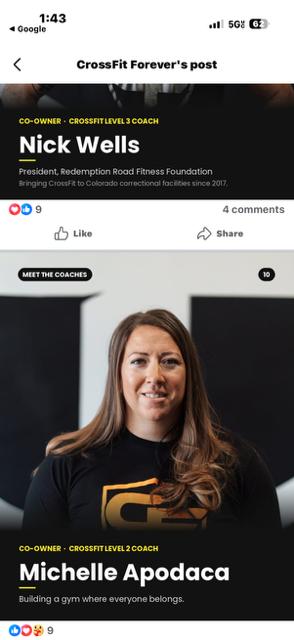
I have seen comments criticizing Roper simply because he is on the sex-offender registry. I have also seen people point out that his surname was not displayed alongside the names of other coaches on the CrossFit Forever website.
I understand why people notice differences in how information is presented. Transparency matters, particularly when a business is facing questions about its staffing.
However, a difference in website listings does not, by itself, establish why that difference occurred or what anyone intended by it. Any claims about changes to the website should be supported by reliable records, and explanations should be sought before motives are assigned.
The larger question remains: what are the actual expectations for people working at this gym, and what safeguards and supervision arrangements are in place?
I have also questioned whether the CrossFit community lives up to its reputation for inclusion. In my view, a community cannot claim to support people through difficult circumstances and then abandon its principles the moment someone becomes controversial.
Of course, nobody is obligated to attend a particular gym. If a member is uncomfortable with the coaching arrangements at CrossFit Forever, that person can choose another facility. Members are entitled to make decisions about where they exercise and whom they trust.
But there is a difference between making an informed personal choice and insisting that an entire category of people must never be allowed to rebuild their lives.
I believe the public discussion should focus on verified facts, individual accountability, appropriate safeguards, and whether the gym is fulfilling its stated mission.
That is a much more productive conversation than an endless stream of insults.
Zach Roper Deserves the Opportunity to Work—With Accountability
Let me make my position clear.
I am not defending the crime for which Roper was convicted. I am not asking anyone to forget the victim. I am not suggesting that his conviction should disappear or that legitimate supervision requirements should be ignored.
I am supporting the principle that people who have served their sentences and are living under applicable supervision conditions should have a meaningful opportunity to work and contribute to society.
If Roper is currently employed at CrossFit Forever, and if the position has been approved under the conditions applicable to his case, that is relevant information. The precise approval and conditions should be verified rather than assumed.
People on parole can be subject to strict requirements. Their employment may need to comply with specific conditions, and their supervising officers may have authority over aspects of their activities.
If an individual violates applicable conditions or commits another offense, there can be serious consequences, including a return to custody. In Roper’s case, the exact consequences would depend on his sentence, parole status, and the governing law.
The public should not assume that every condition is identical for every person.
But neither should the public automatically assume that a person is dangerous in every setting simply because of a conviction.
The whole point of rehabilitation is to assess behavior, encourage accountability, manage risk, and provide a structured path forward.
If we say that people should obtain employment after prison, we cannot then demand that every employer reject them regardless of their circumstances.
If we say that treatment matters, we cannot dismiss the possibility that someone has completed treatment or made progress.
And if we say that people should follow the law, we should recognize the importance of evaluating them according to their actual conduct and applicable conditions—not merely according to public opinion.
That is what a second chance should mean.
Michelle, This Is Your Moment
Michelle, you have an opportunity to show people what CrossFit Forever truly stands for.
If your business is committed to helping people coming out of prison rebuild their lives, then this controversy is a test of that commitment.
I understand that operating a business is not easy. Public criticism can affect memberships, finances, and the reputation you have worked to build. I also understand that owners must consider the safety and comfort of their members, their legal responsibilities, and the needs of their staff.
I am not suggesting that you must make any particular staffing decision regardless of those considerations.
I am asking you to be honest about your principles.
If you believe in second chances, explain what that means in practice. If you have policies for hiring and supervising people with criminal convictions, communicate them appropriately. If there are legitimate safety questions, address them with facts rather than silence or defensiveness.
And if you ultimately decide that Roper should no longer work at your gym, be honest about the reasons for that decision. If you decide to retain him, be equally clear about the principles and safeguards guiding that choice.
Either way, your decision will communicate something about the kind of community you want to build.
I have seen what incarceration does to families. I have seen the barriers people face after release. I have spent years advocating for individuals whom society often finds easier to condemn than to understand.
I do not believe that every person deserves an unlimited number of chances without accountability. I do believe that people should have a realistic opportunity to demonstrate change.
That principle should not depend on whether the person involved is popular, whether the decision is good for business, or whether the public is comfortable with it.
I Am Team Zach—Team Rehabilitation, Team Accountability, Team Second Chances
As an advocate for people convicted of sexual offenses and their families, I am supporting Roper’s opportunity to work and rebuild his life, provided he meets the requirements applicable to him.
That does not mean I approve of his crime. It means I refuse to accept the idea that a person should be permanently reduced to the worst act for which they were convicted, regardless of what happens afterward.
I believe in treatment. I believe in accountability. I believe in appropriate supervision. And I believe in allowing people to demonstrate that they can contribute positively to society.
Those beliefs are not contradictory.
The public can acknowledge the seriousness of Roper’s offense while also recognizing that employment and reintegration can be important parts of a successful return to the community.
The victim’s experience deserves respect. Public safety deserves serious consideration. And rehabilitation deserves more than a slogan.
As for CrossFit Forever, I will be watching how this situation unfolds—not because I want to see anyone fail, but because I want to see whether the principles of second chances survive when they become difficult to defend.
Michelle, you have spent time supporting your husband through incarceration. You know the judgment families can face and the importance of having people who do not automatically turn their backs on someone because of a conviction.
Now you have an opportunity to show whether those lessons extend beyond your own family.
CrossFit can be an extraordinary community when it brings people together, encourages personal growth, and gives people a place to belong. But no community is perfect, and no community should be above criticism.
A true community is not defined by how it treats people when everything is easy. It is defined by how it handles difficult questions, competing responsibilities, and people whose pasts make others uncomfortable.
I have spent too many years advocating for rehabilitation to remain silent when the public conversation becomes nothing more than condemnation.
So, yes, I am Team Zach when it comes to his opportunity to work and build a future under the conditions that apply to him.
And I am Team Second Chances—not because crimes do not matter, but because what happens after a crime matters, too.
As for karma?
Well, karma does not always arrive immediately. Sometimes it takes a while for people to show the world what they truly believe.
Michelle, the ball is in your court. I will be watching—not to see whether you can avoid criticism, but to see whether you stand by the values you have asked others to believe in.
Because second chances are easy to celebrate when they belong to someone you love.
The real test is whether you believe in them when the rest of the world tells you not to.


Leave a Reply