
On October 18, 2026, I published an article titled Society Loves to Talk About Second Chances—Until a Registered Sex Offender Gets a Job at CrossFit Forever. At the time, CrossFit Forever was facing public pressure over having Zach, a registered sex offender, working as a coach. To my understanding, Zach had already been coaching there for some time. There have been plenty of rumors about how people discovered his background, but honestly, that is not the point of this article.
The real issue is hypocrisy.
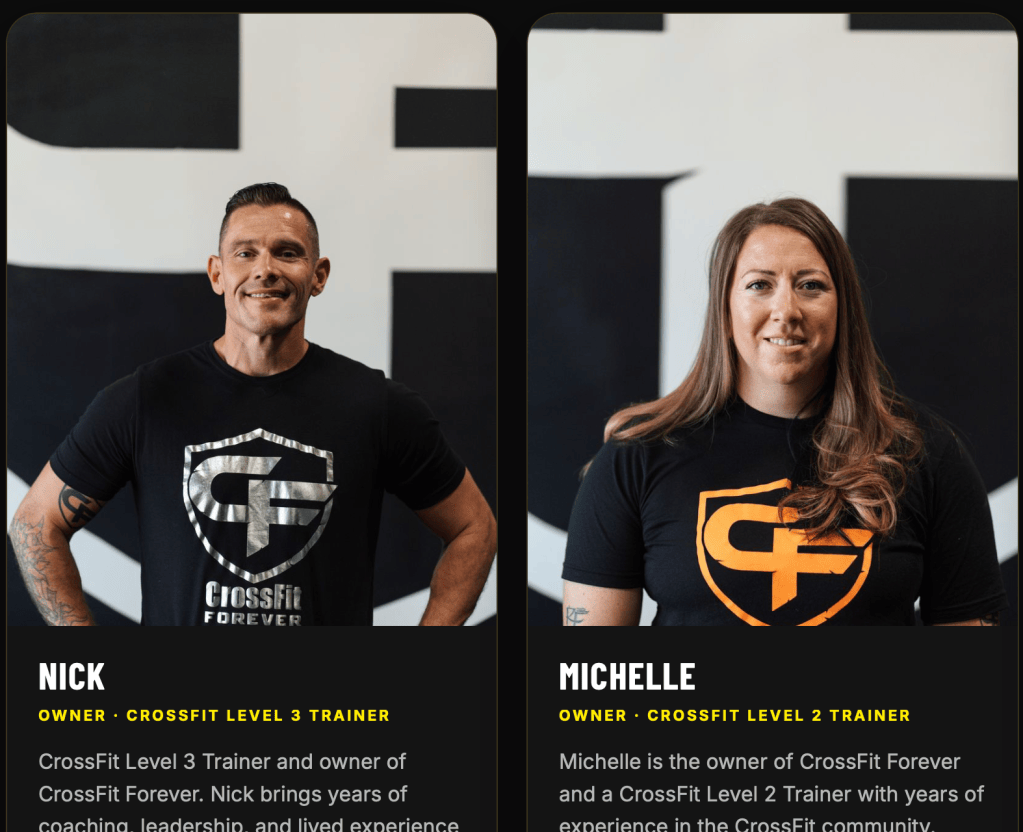
What do CrossFit Forever and Redemption Road Fitness Foundation (RF2) have in common? Nick Wells, who serves as president of RF2 and is apparently associated with the ownership of CrossFit Forever, alongside Michelle Apodaca.
But there is something else readers should understand. My connection to Michelle was personal, and it goes back to a time when she was just beginning to navigate the complicated world of criminal justice advocacy.
I was there when Michelle was trying to find her way.
Michelle is relatively new to criminal justice advocacy. I was one of the people who introduced her to this world, where people are frequently judged, criticized, and defined by the convictions and sentences of their loved ones.
Her husband served a 19-year prison sentence. When Michelle first contacted me, she was inexperienced and uncertain about where to begin. She told me she did not know which direction to take. I encouraged her to find her purpose and start there.
I understood what she was going through. I knew how difficult it could be to stand beside someone who has been incarcerated while dealing with judgment from the outside world. I offered advice, encouragement, and my perspective from years of involvement in criminal justice advocacy.
I did not expect anything in return except basic loyalty and respect.
Unfortunately, our friendship eventually fell apart. In my opinion, Michelle failed to demonstrate the loyalty and respect that I consider essential, particularly in a community where people constantly ask others to stand together against judgment and exclusion.
And then came the situation involving Zach.
From what I understand, Zach is no longer working at CrossFit Forever. I also heard from someone incarcerated who participates in CrossFit and had spoken with Nick Wells that keeping Zach on staff was not considered good for business.
I cannot independently verify that conversation, but if business considerations were behind the decision, it raises a very uncomfortable question.
Was Zach’s second chance worth less than the potential loss of revenue?
Michelle regularly promotes CrossFit Forever and RF2 on social media as organizations built around second chances, supporting people coming out of prison, and helping individuals rebuild their lives.
Those are beautiful words. But words are easy. The real test of someone’s commitment to rehabilitation comes when supporting another person becomes uncomfortable, unpopular, or potentially bad for business.
And this is where I have a serious problem.
Nick Wells should also reflect on his own history. He served approximately 14 years in prison, according to information I have been given, and was sentenced as a habitual offender. He subsequently sought executive clemency from the governor and received it.
Let that sink in for a moment.
Nick Wells sought a second chance from the state, and he received one.
So why should Zach’s opportunity to work, contribute, and rebuild his life be treated differently?
I am not suggesting that everyone’s criminal history is identical. I am asking why an organization that publicly promotes redemption appears, in this situation, to have drawn a line around who deserves an opportunity.
CrossFit Forever is beginning to look like an oxymoron when it comes to second chances.
Zach completed his sentence, participated in Colorado’s Sex Offender Treatment and Monitoring Program (SOTMP), and, according to my understanding, received permission from parole to work at CrossFit Forever.
His presence there was an opportunity to demonstrate something important: being listed on the sex offender registry does not automatically mean that someone will commit another offense or repeat the same behavior.
CrossFit Forever had an opportunity to educate its community. It could have explained that rehabilitation, treatment, supervision, and reintegration matter. It could have encouraged people to look beyond a registry entry and consider the individual’s actual circumstances and progress.
Instead, from what I have observed, the organization chose not to publicly defend that opportunity.
Perhaps the pressure was too much. Perhaps business considerations mattered more. I do not know the private discussions that took place. But the public message is difficult to ignore.
And what message does that send to people still behind prison walls?
What should someone working hard in treatment, following institutional rules, and preparing for release think when an organization that advertises second chances apparently cannot stand behind one of its own coaches when controversy arrives?
Michelle should think carefully about the message she is sending to incarcerated individuals and their families.
Her husband served a lengthy prison sentence. When he eventually returns to the community, he may also face the reality of being judged by people who look at his criminal record before looking at the person he has become.
Will Michelle ask the community to give him a second chance?
Will she ask employers, organizations, and neighbors not to define him exclusively by his past?
I certainly hope she will.
Because if she expects that compassion for her own family, why should she be unwilling to extend the same principle to someone else?
There is another question I believe the Colorado Department of Corrections should consider.
Should CrossFit Forever and Redemption Road Fitness Foundation be welcomed inside CDOC facilities as volunteer organizations promoting rehabilitation and second chances?
If these organizations want to support incarcerated individuals, their philosophy should be consistent. Do they support people with different criminal histories, including those convicted of sex offenses, when those individuals meet applicable institutional and program requirements? Are their fitness opportunities genuinely inclusive, or are second chances available only to people whose criminal histories are more comfortable for the organization and its supporters?
These are legitimate questions. CDOC should be able to ask them before deciding which outside organizations receive access to incarcerated populations.
I also want to address CrossFit itself. I have been involved in CrossFit for more than 15 years. I know the sport, the culture, and the people who participate in it.
Over the years, I have also seen the judgment, criticism, superficiality, and self-absorption that can exist within parts of the CrossFit community. Sometimes the culture seems less about fitness and personal development and more about belonging to an exclusive club where people decide who is acceptable and who is not.
At times, it feels less like a sport and more like a cult of personalities.
Of course, not everyone involved in CrossFit is like that. But my personal experiences have certainly changed how I view the community.
Michelle, you had an opportunity to demonstrate that the values you promote are more than social media announcements and attractive slogans. You had an opportunity to stand behind the principle of second chances when it actually mattered.
Instead, from my perspective, you failed to support someone who was trying to move forward after prison.
And that disappointment is personal because I remember the person who once reached out to me, unsure where to begin, asking for guidance about how to navigate this very world.
I encouraged you to find your purpose. I shared my experience. I believed that you understood what it meant to advocate for people who are constantly judged.
Perhaps I was wrong.
My final question is simple: Are CrossFit Forever and RF2 genuinely committed to second chances, or are they committed to second chances only when those chances do not threaten their business, reputation, or revenue?
You cannot build an organization around redemption and then selectively decide who deserves to be redeemed.
You cannot ask society to look beyond your family’s past while refusing to consider someone else’s progress.
And you cannot preach acceptance to people behind prison walls while sending them a completely different message through your actions.
Michelle, remember something: today you may be asking the community to understand your family. Tomorrow, your family may need that same community to understand you.
Second chances should not be reserved for the people we personally like, the people whose stories make us comfortable, or the people who are good for business.
Otherwise, it is not advocacy. It is marketing.
And Michelle, sometimes the people we disappoint are the very people who once stood beside us when we needed guidance ourselves.
Karma has a way of reminding people of that.


Leave a Reply